e-CF Data & AI
WE-IT project extension, draft for LTA review.
One base, practical additions
We retain the supplied European e-CF catalogue. We add AIET Data/AI task examples and proposed role families. This local project extension is not an official new European standard.
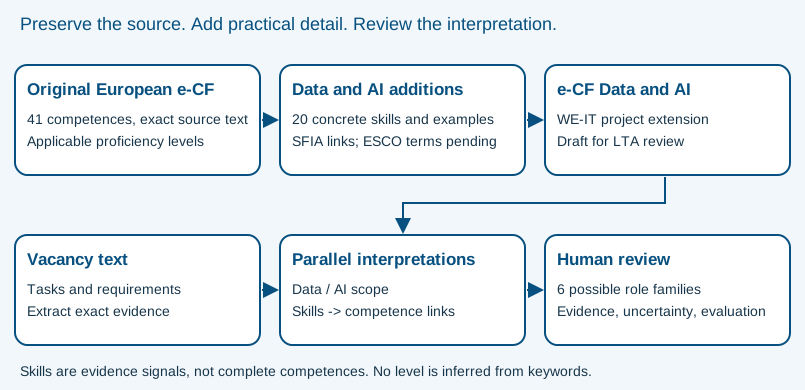
Displayed AIET proposal: weit-ecf-data-ai-0.2, 20 skills, 27 conditional e-CF links, and 6 local role-family sketches.
Operational extraction vocabulary: weit-ecf-data-ai-0.2. The AIET skill choices are used in this local demo at Amey's direction. Informal LTA agreement and formal approval remain pending. Conditional links are hypotheses, not verified matches. Role-family sketches have no thresholds, and the site does not assign proficiency from them.
1. Original European catalogue
41 competences in five areas, with descriptions and the applicable e-1 to e-5 levels. Source: e-CF Explorer. Attributed standards: EN 16234-1:2019 European e-Competence Framework; CWA 16458-1:2018 European ICT Professional Role Profiles. These are the supplied Explorer texts, not an independent certification of the standard.
D.7 already covers analytics and machine learning. A.10, C.5 and D.7 have no knowledge or skill examples in the source. Our added examples remain separate. Not every competence supports all five levels.
Plan: 10 competences
A.1: IS and Business Strategy Alignment
Anticipates long term business requirements, influences improvement of the organisation’s process efficiency and effectiveness. Determines the IS model and enterprise architecture maintaining consistency with organisational policy and ensuring a secure environment. Recognises potential risks and business requirements to assure resilience in the alignment of systems and services to the business strategy. Makes strategic IS policy decisions for the enterprise, including sourcing strategies.
Applicable proficiency levels
e-4: Provides leadership for the construction and implementation of long term innovative IS solutions.
e-5: Provides IS strategic leadership to reach consensus and commitment from the management team of the enterprise.
Published knowledge examples
- business strategy concepts
- trends and implications of ICT internal or external developments for typical organisations
- the potential and opportunities of relevant business models
- the business aims and organisational objectives
- the issues and implications of sourcing models
- the new emerging technologies (e.g. distributed systems, virtualisation, mobility, data sets)
- architectural frameworks
- security
Published skill examples
- analyse future developments in business process and technology application
- determine requirements for processes related to ICT services
- identify and analyse long term user / customer needs
- contribute to the development of ICT strategy and policy, including ICT security and quality
- contribute to the development of the business strategy
- analyse feasibility in terms of costs and benefits
- review and analyse effects of implementations
- understand the impact of new technologies on business (e.g. open / big data, dematerialisation opportunities and strategies)
- understand the business benefits of new technologies and how this can add value and provide competitive advantage (e.g. open / big data, dematerialisation opportunities and strategies)
- understand the enterprise architecture
- understand the legal & regulatory landscape in order to factor into business requirements
A.2: Service Level Management
Defines, validates and makes applicable service level agreements (SLAs) and underpinning contracts tailored to services offered. Negotiates service performance levels taking into account the needs and capacity of stakeholders and business.
Applicable proficiency levels
e-3: Ensures the content of the SLA.
e-4: Negotiates revision of SLAs, in accordance with the overall objectives. Ensures the achievement of planned results.
Published knowledge examples
- SLA documentation
- how to compare and interpret management data
- the elements forming the metrics of service level agreements
- how service delivery infrastructures work
- impact of service level non-compliance on business performance
- ICT security standards
- ICT quality standards
Published skill examples
- analyse service provision records
- evaluate service provision against SLA
- negotiate realistic service level targets
- use relevant quality management techniques
- anticipate and mitigate against potential service disruptions
A.3: Business Plan Development
Addresses the design and structure of a business or product plan including the identification of alternative approaches as well as return on investment propositions. Considers the possible and applicable sourcing models. Presents cost benefit analysis and reasoned arguments in support of the selected strategy. Ensures compliance with business risk and technology strategies. Communicates and sells business plan to relevant stakeholders and addresses political, financial, and organisational interests.
Applicable proficiency levels
e-3: Exploits specialist knowledge to provide analysis of market environment etc.
e-4: Provides leadership for the creation of an information system strategy that meets the requirements of the business (e.g. distributed, mobility-based) and includes risks and opportunities.
e-5: Applies strategic thinking and organisational leadership to exploit the capability of Information Technology to improve or transform the business.
Published knowledge examples
- business plan elements and milestones
- the present and future market size and needs
- competition and SWOT analysis techniques (for product features and also the external environment)
- value creation channels
- profitability elements
- the issues and implications of sourcing models
- financial planning and dynamic
- new emerging technologies
- risk and opportunity assessment techniques
Published skill examples
- address and identify essential elements of product or solution value propositions
- define the appropriate value creation channels
- build a detailed SWOT analysis
- generate short and long term performance reports (e.g. financial, profitability, usage and value creation)
- identify main milestones of the plan
A.4: Product / Service Planning
Analyses and defines current and target status. Estimates cost effectiveness, points of risk, opportunities, strengths and weaknesses, with a critical approach. Creates structured plans; establishes time scales and milestones, ensuring optimisation of activities and resources. Manages services portfolio and change requests. Defines delivery quantity and provides an overview of additional documentation requirements. Specifies correct handling of products in accordance with current legislation.
Applicable proficiency levels
e-2: Systematically documents standard and simple elements of a product.
e-3: Exploits specialist knowledge to create and maintain complex documents.
e-4: Provides leadership and takes responsibility for, developing and maintaining overall plans.
Published knowledge examples
- effective frameworks and methodologies for governance plans
- typical KPI (key performance indicators)
- basic decision-making methods
- IPR principles and regulation
- agile techniques
- structured Project Management Methodologies (e.g. agile techniques)
- optimisation methods (e.g. lean management)
- new emerging technologies
Published skill examples
- identify all potential targets for the product or service
- define the communication plan; identify key users and create related documentation
- produce quality plans
- ensure and manage adequate information for decision makers
- manage the change request process
- S7 manage the product / service development management lifecycle (inclusive of the formal change request process)
A.5: Architecture Design
Specifies, refines, updates and makes available a formal approach to implement solutions and services, necessary to develop and operate the IS architecture, taking into account the requirements from business, management and data and information infrastructure. Identifies change requirements and the components involved: hardware, software, applications, processes, services, information and technology platform. Takes into account interoperability, reversibility, scalability, usability, accessibility and security, including the need to account for the development and management of vulnerability within existing and emerging technologies. Maintains alignment between business evolution and technology developments and services to ensure capacity of IT solutions according to SLA.
Applicable proficiency levels
e-3: Exploits specialist knowledge to define relevant ICT technology and specifications to be deployed in the construction of multiple ICT projects, applications or infrastructure improvements.
e-4: Acts with wide ranging accountability to define the strategy to implement ICT technology compliant with business need. Takes account of the current technology platform, obsolescent equipment and latest technological innovations.
e-5: Provides strategic leadership for implementing the digital enterprise strategy. Applies strategic thinking to discover and recognize new patterns in data sets and new ICT systems, to achieve business benefits.
Published knowledge examples
- architecture frameworks, methodologies and systems design tools
- systems architecture requirements: performance, maintainability, extendibility, scalability, availability, security and accessibility
- costs, benefits and risks of a system architecture
- the company’s enterprise architecture and internal standards
- new emerging technologies (e.g., distributed systems, virtualisation models, datasets, mobile systems)
Published skill examples
- provide expertise to help solve complex technical problems and ensure best architecture solutions are implemented
- use knowledge in various technology areas to build and deliver the enterprise architecture
- understand the business objectives / drivers that impact the architecture component (data, application, security, development etc)
- assist in communication of the enterprise architecture and standards, principles and objectives to the application teams
- develop design patterns and models to assist system analysts in designing consistent applications
A.6: Application Design
Analyses, specifies, updates and makes available a model to implement applications in accordance with IS policy and user/customer needs. Selects appropriate technical options for application design, optimising the balance between cost and quality. Designs data structures and builds system structure models according to analysis results through modelling languages. Ensures that all aspects take account of interoperability, usability, accessibility and security. Identifies a common reference framework to validate the models with representative users, based upon development models (e.g. iterative approach).
Applicable proficiency levels
e-1: Contributes to the design and general functional specification and interfaces.
e-2: Organises the overall planning of the design of the application.
e-3: Accounts for own and others actions in ensuring that the application is correctly integrated within a complex environment and complies with user / customer needs.
Published knowledge examples
- requirements modelling and need analysis techniques
- software developments methods and their rationale (e.g. prototyping, agile methods, reverse engineering, etc.)
- metrics related to application development
- user interface design principles
- languages for formalising functional specification
- existing applications and related architecture
- DBMS, Data Warehouse, DSS … etc
- mobile technologies
- threat modelling techniques
Published skill examples
- identify customers, users and stakeholders
- collect, formalise and validate functional and no-functional requirements
- apply estimation models and data to evaluate costs of different software lifecycle phases
- evaluate the use of prototypes to support requirements validation
- design, organise and monitor the overall plan for the design of application
- S6 design functional specification starting from defined requirements
- S7 evaluate the suitability of different application development methods for the current scenario
- S8 establish systematic and frequent communication with customers, users and stakeholders
- S9 ensure that controls and functionality are built in to the design
A.7: Technology Trend Monitoring
Investigates latest ICT technological developments to establish understanding of evolving technologies. Encourages and explores internal and external sources (including e.g. research activities, patents, start-up activities, digital communities) for innovative ideas and opportunities. Devises innovative solutions for the adoption or integration of existing or new technology and/or ideas into existing products, applications or services or for the creation of new ones.
Applicable proficiency levels
e-3: Detects signs of change to provide supervision and analysis of current and trend-setting ICT technological developments. Establishes relationships with relevant communities.
e-4: Validates new and emerging technologies, coupled with expert understanding of the business, to envision and articulate solutions for the future. Creates the organisation wide trend monitoring processes.
e-5: Plans and leads an organisational structure and support system for systematic technology watch. Advises and influences strategic decisions envisioning and articulating future ICT solutions.
Published knowledge examples
- emerging technologies and the relevant market applications
- market needs
- relevant sources of information (e.g. magazines, conferences and events, newsletters, opinion leaders, on-line forum, etc.)
- the rules of discussions in web communities
- applied research programme approaches
Published skill examples
- monitor sources of information and continuously follow the most promising
- identify vendors and providers of the most promising solutions; evaluate, justify and propose the most appropriate.
- identify business advantages and improvements of adopting emerging technologies
A.8: Sustainability Management
Estimates the impact of ICT solutions in terms of eco responsibilities, including energy consumption, waste treatment and environmental policy. Analyses the prospects and impacts in social and financial sustainability of ICT projects, developments, services and operations. Advises business and ICT stakeholders on sustainable options that are consistent with the business strategy. Applies an ICT purchasing and sales policy which fulfills eco-responsibilities.
Applicable proficiency levels
e-3: Promotes awareness, training and commitment for the deployment of sustainable development and applies the necessary tools for piloting this approach.
e-4: Defines the strategy of sustainable IS development and digital services. Provides input into the business strategy to ensure that sustainability is considered and incorporated.
Published knowledge examples
- metrics and indicators related to sustainable development
- corporate social responsibility (CSR) of stakeholders within the IS infrastructure
Published skill examples
- monitor and measure the ICT energy consumption
- apply recommendations in projects to support latest sustainable development strategies
- master regulatory constraints and international standards related to ICT sustainability
A.9: Innovating
Devises creative solutions for the provision of new concepts, ideas, products or services. Deploys novel and open thinking to envision exploitation of technological advances to address business / society needs or research direction.
Applicable proficiency levels
e-4: Applies independent thinking and technology awareness to lead the integration of disparate concepts for the provision of unique solutions.
e-5: Provides strategic leadership for the introduction of new concepts. Guides innovation approaches and leads the cultural change to innovation.
Published knowledge examples
- existing and emerging technologies and market applications
- business, society and / or research habits, trends and needs
- innovation processes techniques
Published skill examples
- identify business advantages and improvements of adopting emerging technologies
- create a proof of concept
- think out of the box
- identify appropriate resources
A.10: User Experience
Appreciates and applies the foundational principles of human-computer-interaction to create digital products and services that are intuitive, easy to use, safe and efficient. Understands users needs and goals, applies understanding of user behaviour to develop alternative options and functions, of the digital product, to create a seamless user experience.
Applicable proficiency levels
e-2: Applies digital interfaces options (web, mobile, IoT) and guidelines to achieve usability for all.
e-3: Establishes and cultivates relationships with customers and users to understand their tasks, needs and goals. Uses specialist methods to obtain a wide range of significant user engagement.
e-4: Provides expert guidance to ensure continuous improvement and establish a successful omni-channel user experience.
Published knowledge examples
- No examples in this catalogue.
Published skill examples
- No examples in this catalogue.
Build: 6 competences
B.1: Application Development
Interprets the application design to develop a suitable application in accordance with customer needs. Adapts existing solutions by e.g. porting an application to another operating system. Codes, debugs, tests and documents and communicates product development stages. Selects appropriate technical options for development such as reusing, improving or reconfiguration of existing components. Optimises efficiency, cost and quality. Validates results with user representatives, integrates and commissions the overall solution.
Applicable proficiency levels
e-1: Acts under guidance to develop, test and document applications.
e-2: Systematically develops and validates applications.
e-3: Acts creatively to develop applications and to select appropriate technical options. Accounts for others development activities. Optimizes application development, maintenance and performance by employing design patterns and by reusing proved solutions.
Published knowledge examples
- appropriate software programs / modules
- hardware components, tools and hardware architectures
- functional and technical designing
- state of the art technologies
- programming languages
- Power consumption models of software and / or hardware
- DBMS
- operating Systems and software platforms
- Integrated development environment (IDE)
- rapid application development (RAD)
- IPR issues
- modeling technology and languages
- interface definition languages (IDL)
- security
Published skill examples
- explain and communicate the design / development to the customer
- perform and evaluate test results against product specifications
- apply appropriate software and / or hardware architectures
- develop user interfaces, business software components and embedded software components
- manage and guarantee high levels of cohesion and quality
- S6 use data models
- S7 perform and evaluate test in the customer or target environment
- S8 cooperate with development team and with application designers
B.2: Component Integration
Integrates hardware, software or sub system components into an existing or a new system. Complies with established processes and procedures such as, configuration management and package maintenance. Takes into account the compatibility of existing and new modules to ensure system integrity, system interoperability and information security. Verifies and tests system capacity and performance and documentation of successful integration.
Applicable proficiency levels
e-2: Acts systematically to identify compatibility of software and hardware specifications. Documents all activities during installation and records deviations and remedial activities.
e-3: Accounts for own and others actions in the integration process. Complies with appropriate standards and change control procedures to maintain integrity of the overall system functionality and reliability.
e-4: Exploits wide ranging specialist knowledge to create a process for the entire integration cycle, including the establishment of internal standards of practice. Provides leadership to marshal and assign resources for programs of integration.
Published knowledge examples
- old, existing and new hardware components / software programs / modules
- the impact that system integration has on existing system / organisation
- interfacing techniques between modules, systems and components
- integration testing techniques
- development tools (e.g. development environment, management, source code access / revision control)
- best practice design techniques
Published skill examples
- measure system performance before, during and after system integration
- document and record activities, problems and related repair activities
- match customers’ needs with existing products
- verify that integrated systems capabilities and efficiency match specifications
- secure / back-up data to ensure integrity during system integration
B.3: Testing
Constructs and executes systematic test procedures for ICT systems or customer usability requirements to establish compliance with design specifications. Ensures that new or revised components or systems perform to expectation. Ensures meeting of internal, external, national and international standards; including health and safety, usability, performance, reliability or compatibility. Produces documents and reports to evidence certification requirements.
Applicable proficiency levels
e-1: Performs simple tests in strict compliance with detailed instructions.
e-2: Organises test programs and builds scripts to stress test potential vulnerabilities. Records and reports outcomes providing analysis of results.
e-3: Exploits specialist knowledge to supervise complex testing programmes. Ensures tests and results are documented to provide input to subsequent process owners such as designers, users or maintainers. Accountable for compliance with testing procedures including a documented audit trail.
e-4: Exploits wide ranging specialist knowledge to create a process for the entire testing activity, including the establishment of internal standard of practices. Provides expert guidance and advice to the testing team.
Published knowledge examples
- techniques, infrastructure and tools to be used in the testing process
- the lifecycle of a testing process
- the different sorts of tests (functional, integration, performance, usability, stress etc.)
- national and international standards defining quality criteria for testing
- web, cloud and mobile technologies and environmental requirements
Published skill examples
- create and manage a test plan
- manage and evaluate the test process
- design tests of ICT systems
- prepare and conduct tests of ICT systems
- report and document tests and results
B.4: Solution Deployment
Following predefined general standards of practice carries out planned necessary interventions to implement solutions and services, including installing, securing, upgrading or decommissioning. Configures hardware, software or network to ensure interoperability of system components and debugs any resultant faults, incompatibilities or losses (damage). Engages additional specialist resources if required, such as third-party network providers. Formally hands over fully operational solution to user ICT management, and completes documentation recording all relevant information, including equipment addressees, configuration and performance data.
Applicable proficiency levels
e-1: Removes or installs components under guidance and in accordance with detailed instructions.
e-2: Acts systematically to build or deconstruct system elements. Identifies failing components and establishes root cause failures. Provides support to less experienced colleagues.
e-3: Accounts for own and others actions for solution provision and initiates comprehensive communication with stakeholders. Exploits specialist knowledge to influence solution construction providing advice and guidance.
Published knowledge examples
- performance analysis techniques
- techniques related to problem management (operation, performance, compatibility)
- software packaging and distribution methods and techniques
- the impacts of deployment on the current architecture
- the technologies and standards to be used during the deployment
- web, cloud and mobile technologies and environmental requirements
Published skill examples
- organise deployment workflow and product roll-out activities
- organise and plan beta-test activities, testing solution in its final operational environment
- configure components at any level to guarantee correct overall interoperability
- identify and engage expertise needed to solve interoperability problems
- organise and control initial support service provision including user training during system start-up
- S7 organise population of data bases and manage data migration
- S7 collaborate to modify 3rd party code; support and maintain modified software
B.5: Documentation Production
Produces documents by integrating information and maintaining compliance with relevant requirements. Selects the appropriate style and format by determining the media type and presentation mode of the documentation. Creates templates for document-management systems. Ensures that documentation complies with customers’, technical and ICT application development process needs and that existing documents are valid and up to date. Provides support for the development of interactive documents.
Applicable proficiency levels
e-1: Uses and applies standards to define document structure.
e-2: Ensures that documentation is complete, correct and provided in a suitable place and format.
e-3: Adapts the level of detail to meet the needs of the targeted population.
Published knowledge examples
- tools for production, editing and distribution of professional documents
- tools for multimedia presentation creation
- different technical documents required for designing, developing and deploying products, applications and services
- version control of documentation production
Published skill examples
- observe and deploy effective use of corporate standards for publications
- prepare templates for shared publications
- organise and control content management workflow
- keep publications aligned to the solution during the entire lifecycle
B.6: ICT Systems Engineering
Builds the required networks/network connections, components and interfaces. Follows a systematic methodology to analyse and engineer infrastructure platforms or solutions for cloud, IoT and other technologies to meet business and technical requirements. Builds system structure models and conducts system behaviour to integrate physical devices, networks, hardware and/or software components. Ensures information security, data protection and energy efficiency. Performs tests to ensure requirements are met.
Applicable proficiency levels
e-3: Ensures interoperability of the system components. Exploits wide ranging specialist knowledge to create a digital infrastructure that will satisfy the system constraints and meet the customer’s expectations.
e-4: Handles complexity by developing standard procedures and architectures in support of cohesive product development. Establishes a set of system requirements that will guide the design of the digital infrastructure. Identifies which system requirements and which functions should be allocated to which elements of the system and/or layers of the infrastructure.
Published knowledge examples
- appropriate software programs / modules, DBMS and programming languages
- hardware components, tools and hardware architectures
- functional and technical designing
- state of the art technologies
- programming languages
- power consumption models of software and / or hardware
- information Security Basics
- prototyping
Published skill examples
- explain and communicate the design / development to the customer
- perform and evaluate test results against product specifications
- apply appropriate software and / or hardware architectures
- design and develop hardware architecture, user interfaces, business software components and embedded software components
- manage and guarantee high levels of cohesion and quality in complex software developments
- S7 use data models
- S7 apply appropriate development and / or process models, to develop effectively and efficiently
Run: 5 competences
C.1: User Support
Responds to user requests and issues, recording relevant information. Assures resolution or escalates incidents and optimises system performance in accordance with predefined service level agreements (SLAs). Understands how to monitor solution outcome and resultant customer satisfaction.
Applicable proficiency levels
e-1: Interacts with users, applies basic product knowledge to respond to user requests. Solves incidents, following prescribed procedures.
e-2: Systematically interprets user problems and identifies solutions and possible side effects. Uses experience to address user problems and interrogates database for potential solutions. Escalates complex or unresolved incidents. Records and tracks issues from outset to conclusion.
e-3: Manages the support process and accountable for agreed SLA. Plans resource allocation to meet defined service level. Acts creatively, and applies continuous service improvement. Manages the support function budget.
Published knowledge examples
- relevant ICT user applications
- database structures and content organisation
- corporate escalation procedures
- software distribution methods and procedures for fix application and file transmission methodologies applicable to software fixes
- sources of information for potential solutions
Published skill examples
- effectively interrogate users to establish symptoms
- analyse symptoms to identify broad area of user error or technical failure
- deploy support tools to systematically trace source of error or technical failure
- clearly communicate with end users and provide instructions on how to progress issues
- record and code issues to support growth and integrity of online support tools
C.2: Change Support
Evaluates, implements and guides the evolution of an ICT solution evaluating changes and their impact. Ensures efficient control and scheduling of software or hardware modifications to prevent multiple upgrades creating unpredictable outcomes. Minimises service disruption as a consequence of changes and adheres to defined service level agreement (SLA). Ensures consideration and compliance with information security procedures.
Applicable proficiency levels
e-2: During change, acts systematically to respond to day by day operational needs and react to them, avoiding service disruptions and maintaining coherence to (SLA) and information security requirements.
e-3: Ensures the integrity of the system by controlling the application of functional updates, software or hardware additions and maintenance activities. Complies with budget requirements.
Published knowledge examples
- functional specifications of the information system
- the existing ICT application technical architecture
- how business processes are integrated and their dependency upon ICT applications
- change management tools and technique
- the best practices and standards in information security management
Published skill examples
- share functional and technical specifications with ICT teams in charge of the maintenance and evolution of ICT solutions
- manage communications with ICT teams in charge of the maintenance and the evolution of information systems solutions
- analyse the impact of functional / technical changes on users
- anticipate all actions required to mitigate the impact of changes (training, documentation, new processes…).
C.3: Service Delivery
Ensures service delivery in accordance with established service level agreements (SLA's). Takes proactive action to ensure stable and secure applications and ICT infrastructure to avoid potential service disruptions, attending to capacity planning and to information security. Updates operational document library and logs all service incidents. Maintains monitoring and management tools (i.e. scripts, procedures). Maintains IS services. Manages all aspects of service availability.
Applicable proficiency levels
e-1: Acts under guidance to record and track reliability data.
e-2: Systematically analyses performance data and communicates findings to senior experts. Escalates potential service level failures and security risks, recommends actions to improve service reliability. Tracks reliability data against SLA.
e-3: Plans the schedule of operational tasks. Manages costs and budget according to the internal procedures and external constraints. Identifies the optimum number of people required to resource the operational management of the IS infrastructure.
Published knowledge examples
- how to interpret ICT service delivery requirements
- best practices and standards in ICT service delivery.
- how to monitor service delivery
- how to record service delivery actions and able to identify failures
- the best practices and standards in information security management
- web, cloud and mobile technologies
Published skill examples
- apply the processes which comprise the organisation’s ICT service delivery strategy
- fill in and complete documentation used in ICT service delivery
- analyse service delivery provision and report outcomes to senior colleagues
- plan and apply manpower workload / requirements for efficient and cost effective service provision
C.4: Problem Management
Manages the life cycle of incidents and problems. Identifies and resolves the root cause of incidents. Takes a proactive approach to avoidance or identification of root cause of ICT problems. Deploys a knowledge system based on recurrence of common errors. Resolves or escalates incidents. Optimises system or component performance.
Applicable proficiency levels
e-2: Identifies and classifies incident types and service interruptions. Records incidents cataloguing them by symptom and resolution.
e-3: Exploits specialist knowledge and in-depth understanding of the ICT infrastructure and problem management process to identify failures and resolve with minimum outage. Makes sound decisions in emotionally charged environments on appropriate action required to minimise business impact. Rapidly identifies failing component, selects alternatives such as repair, replace or reconfigure.
e-4: Provides leadership and is accountable for the entire problem management process. Schedules and ensures well trained human resources, tools, and diagnostic equipment are available to meet emergency incidents. Has depth of expertise to anticipate critical component failure and make provision for recovery with minimum downtime. Constructs escalation processes to ensure that appropriate resources can be applied to each incident.
Published knowledge examples
- the organisation’s overall ICT infrastructure and key components
- the organisation’s reporting procedures
- the organisation’s critical situation escalation procedures
- the application and availability of diagnostic tools
- the link between system infrastructure elements and impact of failure on related business processes.
Published skill examples
- monitor progress of issues throughout lifecycle and communicate effectively
- identify potential critical component failures and take action to mitigate effects of failure
- conduct risk management audits and act to minimise exposures
- allocate appropriate resources to maintenance activities, balancing cost and risk
- communicate at all levels to ensure appropriate resources are deployed internally or externally to minimise outages
C.5: Systems Management
Monitors and controls the IT services and their underlying physical systems and hardware. Manages the hardware, applications, networks, servers, virtual resources and other technical systems. Ensures up-to-date administration of resources, users and authentications. Manages devices in bring-your-own (BYOD) organisation, enabling user productivity and flexibility, preventing data loss, and enhancing data security.
Applicable proficiency levels
e-1: Performs basic systems operations.
e-2: Systematically manages day by day operational needs across the IT system, avoiding service disruptions according to service and information security strategy.
e-3: Optimizes technical and cloud environment. Evaluates performance of systems and the problems/questions of users. Responsible for timely replacement of resources within the permitted budget.
Published knowledge examples
- No examples in this catalogue.
Published skill examples
- No examples in this catalogue.
Enable: 11 competences
D.1: Information Security Strategy Development
Defines and makes applicable a formal organisational strategy, scope and culture to maintain safety and security of information from external and internal threats. Analyses the business and technology strategy alongside trends in the threat landscape to anticipate potential vulnerabilities and risk mitigation requirements. Tracks legal, regulatory and social expectations involving the security of services and sensitive data. Provides the foundation for Information Security Management, including role identification and accountability. Uses defined standards to create objectives for information integrity, availability, and data privacy.
Applicable proficiency levels
e-4: Exploits depth of expertise and leverages external standards and best practices
e-5: Provides strategic leadership to embed information security into the culture of the organisation
Published knowledge examples
- the potential and opportunities of relevant standards and best practices
- the impact of legal requirements on information security
- the information strategy of the organisation
- possible security threats
- the mobility strategy
- the different service models (SaaS, PaaS, IaaS) and operational translations (i.e. Cloud Computing)
Published skill examples
- develop and critically analyse the company strategy for information security
- define, present and promote an information security policy for approval by the senior management of the organisation
- apply relevant standards, best practices and legal requirements for information security
- anticipate required changes to the organisation’s information security strategy and formulate new plans
- propose effective contingency measures
D.2: ICT Quality Strategy Development
Defines, improves and refines a formal strategy to satisfy customer expectations and improve business performance (balance between cost and risks). Identifies critical processes influencing service delivery and product performance for definition in the ICT quality management system. Uses defined standards to formulate objectives for service management, product, data and process quality. Identifies ICT quality management accountability.
Applicable proficiency levels
e-4: Exploits wide ranging specialist knowledge to leverage and authorise the application of external standards and best practices
e-5: Provides strategic leadership to embed ICT quality (i.e. metrics and continuous improvement) into the culture of the organisation.
Published knowledge examples
- the major information technology industry frameworks, e.g. COBIT, ITIL, CMMI, ISO, and their implications for corporate IS governance
- the information strategy of the organisation
- the different service models (SaaS, PaaS, IaaS) and operational translations (i.e. Cloud Computing)
Published skill examples
- define an ICT quality policy to meet the organisation’s standards of performance and customer satisfaction objectives
- identify quality metrics to be used
- apply relevant standards and best practices to maintain information quality
D.3: Education and Training Provision
Defines and implements ICT training policy to address organisational skill needs and gaps. Incorporates these onto internal employee development plans as a tool for enabling career development. Structures, organises and schedules training programs and evaluates training quality through a feedback process and implements continuous improvement. Adapts training plans to address changing demand.
Applicable proficiency levels
e-2: Organises the identification of training needs; collates organisation requirements, identifies, selects and prepares schedule of training interventions.
e-3: Acts creatively to analyse skills gaps; elaborates specific requirements and identifies potential sources for training provision. Has specialist knowledge of the training market and establishes a feedback mechanism to assess the added value of alternative training programmes.
Published knowledge examples
- appropriate pedagogical approaches and education delivery methods e.g. classroom, online, text, dvd
- the competitive market for educational offering
- training needs analysis methodologies
- empowerment techniques
Published skill examples
- organise training and education schedules to meet market needs
- identify and maximise use of resources required to deliver a cost effective schedule
- promote and market education and training provision
- analyse feedback data and use it to drive continuous improvement of education and training delivery
- design curricula and training programmes to meet customer ICT education needs
- S7 address CPD needs of staff to meet organisational requirements
D.4: Purchasing
Applies a consistent procurement procedure, including deployment of the following sub processes: specification requirements; supplier identification; proposal analysis; evaluation of the energy efficiency and environmental compliance of products; suppliers and their processes; contract negotiation; supplier selection and contract placement. Ensures that the entire purchasing process is fit for purpose, compliant to legal requirements and adds value to the organisation.
Applicable proficiency levels
e-2: Understands and applies the principles of the procurement process; places orders based on existing supplier contracts. Ensures the correct execution of orders, including validation of deliverables and correlation with subsequent payments.
e-3: Exploits specialist knowledge to deploy the purchasing process, ensuring positive commercial relationships with suppliers. Selects suppliers, products and services by evaluating performance, cost, timeliness and quality. Decides contract placement and complies with organisational policies.
e-4: Provides leadership for the application of the organisation’s procurement policies and makes recommendations for process enhancement. Applies experience and procurement practice expertise to make ultimate purchasing decisions
Published knowledge examples
- typical purchase contract terms and conditions
- own organisation purchasing policies
- financial models e.g. discount structures
- the current market for relevant products or services
- the issues and implications of outsourcing services
- different service models (SaaS, PaaS, IaaS) and operational translations (e.g. Cloud Computing)
Published skill examples
- interpret product / service specifications
- negotiate terms, conditions and pricing
- analyse received proposals / offers
- manage the purchasing budget
- lead purchase process improvement
- analyse the energy efficiency and environmental-related aspects of a proposal
- verify that purchasing processes respect legal issues including IPR
D.5: Sales Development
Establishes a systematic process for the sales and marketing of the organisation’s products and services, including value-added resellers (VARs) if appropriate; including understanding of customer needs, sales forecasting, prospect evaluation and negotiation tactics. Develops technical proposals to meet customer solution requirements and offer competitive bids aligned with the organisation’s capacity to deliver.
Applicable proficiency levels
e-2: Collaborates in the development of proposals compliant with business capacity and customer requirements.
e-3: Acts creatively to develop proposals incorporating complex solutions. Customises solutions in a complex technical and legal environment ensuring the feasibility, legal and technical validity of the customer offer.
e-4: Reviews and implements appropriate sales strategy to deliver organization goals. Determines and allocates targets to address market conditions. Coordinates multidisciplinary teams.
Published knowledge examples
- customer needs
- internally adopted sales and marketing techniques
- legal requirements
- internal business practices
- product or service unique selling points
- the different service models (SaaS, PaaS, IaaS) and operational translations (e.g. Cloud Computing)
Published skill examples
- construct the framework for proposal documentation
- co-ordinate and facilitate multidisciplinary teams contributing to the proposal
- interpret the terms and conditions of the tender documentation
- evaluate the strengths and weaknesses of potential competitors
- ensure that a proposal is of high quality and is submitted on time
- S6 communicates the energy efficiency and environmental-related aspects of a proposal
- S7 ensure that proposals meet compliance requirements
D.6: Digital Marketing
Understands the fundamental principles of digital marketing. Distinguishes between the traditional and digital approaches. Appreciates the range of channels available. Assesses the effectiveness of the various approaches and applies rigorous measurement techniques. Plans a coherent strategy using the most effective means available. Understands the data protection and privacy issues involved in the implementation of the marketing strategy.
Applicable proficiency levels
e-2: Understands and applies digital marketing tactics to develop an integrated and effective digital marketing plan using different digital marketing areas such as search, display, e-mail, social media and mobile marketing.
e-3: Exploits specialist knowledge to utilise analytical tools and assess the effectiveness of websites in terms of technical performance and download speed. Evaluates the user engagement by the application of a wide range of analytical reports. Knows the legal implications of the approaches adopted.
e-4: Develops clear meaningful objectives for the Digital Marketing Plan. Selects appropriate tools and sets budget targets for the channels adopted. Monitors, analyses and enhances the digital marketing activities in an ongoing manner.
Published knowledge examples
- marketing strategy
- web technologies
- search engine marketing (PPC)
- search engine optimization (SEO)
- mobile marketing (e.g. Pay Per Click)
- social media marketing
- e-mail marketing
- display marketing
- legal issues / requirements
Published skill examples
- understand how web technology can be used for marketing purposes
- understand User Centric Marketing
- use and interpret web analytics
- understand the on-line environment
D.7: Data Science and Analytics
Uses and applies data analytic techniques such as data mining, machine learning, prescriptive and predictive analytics to apply data insight to address the organisation’s challenges and opportunities. Identifies, extracts and integrates heterogeneous data from a wide range of sources respecting ethical aspects and guaranteeing compliance with data privacy regulations. Assesses existing data and identifies new data requirements including social networks and open data for organisational benefit.
Applicable proficiency levels
e-2: Searches and collects data. Prepares data from multiple sources and formats for analysis.
e-3: Designs and creates data analysis tools to support the organisations data lifecycle. Verifies data veracity. Processes data and visualises the data analysis results to the given domain.
e-4: Interprets data analysis results. Performs proper data business analysis. Delivers insight into the organisations data requirements, plan, design, develop and recommend new data sources. Creates new models and algorithms for data driving the strategy. Organizes, synthesizes and translates information to facilitate decision-making.
e-5: Provides leadership to optimise how data is used in the organisation to drive innovation. Uses data to improve processes and to feed/ develop business strategy.
Published knowledge examples
- No examples in this catalogue.
Published skill examples
- No examples in this catalogue.
D.8: Contract Management
Provides and negotiates contract in accordance with organisational processes. Ensures that contract and deliverables are provided on time, meet quality standards, and conform to compliance requirements. Addresses non-compliance, escalates significant issues, drives recovery plans and if necessary amends contracts. Maintains budget integrity. Assesses and addresses supplier compliance to legal, health and safety and security standards. Establishes and maintains supplier relationships and regular communication.
Applicable proficiency levels
e-2: Acts systematically to monitor contract compliance and promptly escalate defaults.
e-3: Evaluates contract performance by monitoring performance indicators. Assures performance of the complete supply chain. Influences the terms of contract renewal.
e-4: Provides leadership for contract compliance and is the final escalation point for issue resolution
Published knowledge examples
- applicable SLA
- company policy for contract management
- legal regulations applicable to ICT contracts
- legal issues including IPR
- different service models (SaaS, PaaS, IaaS), service levels and contractual translations (e.g. Cloud Computing)
Published skill examples
- foster positive relationships with stakeholders
- negotiate contract terms and conditions
- apply judgment and flexibility in contract negotiations compliant with internal rules and policies
D.9: Personnel Development
Diagnoses individual and group competence, identifying skill needs and skill gaps. Reviews training and development options and selects appropriate methodology taking into account the individual, project and business requirements. Coaches and/ or mentors individuals and teams to address learning needs.
Applicable proficiency levels
e-2: Briefs / trains individuals and groups, holds courses of instruction
e-3: Monitors and addressees the development needs of individuals and teams.
e-4: Takes proactive action and develops organisational processes to address the development needs of individuals, teams and the entire workforce
Published knowledge examples
- competence development methods
- competence and skill needs analysis methodologies
- learning and development support methods (e.g. coaching, teaching)
- technology and processes
- empowerment techniques
Published skill examples
- identify competence and skill gaps
- identify and recommend work based development opportunities
- incorporate within routine work processes, opportunities for skills development
- coach
- address professional development needs of staff to meet organisational requirements
D.10: Information and Knowledge Management
Identifies information and knowledge relevant to the organisation and develops processes and structures to manage it. Creates information structure to enable the exploitation, optimisation and sharing of information. Understands appropriate tools to be deployed to create, extract, maintain, renew and propagate business knowledge in order to capitalise from the information asset.
Applicable proficiency levels
e-3: Analyses business processes and associated information requirements and provides the most appropriate information structure
e-4: Integrates the appropriate information structure into the corporate environment.
e-5: Correlates information and knowledge to create value for the business. Applies innovative solutions based on information retrieved
Published knowledge examples
- methods to analyse information and business processes
- ICT devices and tools applicable for the storage and retrieval of data
- challenges related to the size of data sets (e.g. big data)
- challenges related to unstructured data (e.g. data analytics)
Published skill examples
- gather internal and external knowledge and information needs
- formalise customer requirements
- translate / reflect business behaviour into structured information
- make information available
- ensure that IPR and privacy issues are respected
- S6 capture, storage, analyse, data sets, that are complex and large, not structured and in different formats
- S7 apply data mining methods
D.11: Needs Identification
Actively listens to internal/ external customers, articulates and clarifies their needs. Manages the relationship with all stakeholders to ensure that solutions and services are in line with business requirements. Proposes different solutions (e.g. make-or-buy), by performing contextual analysis in support of user centered system design. Advises the customer on appropriate solution choices. Acts as an advocate engaging in the implementation or configuration process of the chosen solution.
Applicable proficiency levels
e-3: Establishes reliable relationships with customers and helps them clarify their needs.
e-4: Exploits wide ranging specialist knowledge of the customers business to offer possible solutions to business needs. Provides expert guidance to the customer by proposing solutions and supplier.
e-5: Provides leadership in support of the customers’ strategic decisions. Helps customer to envisage new ICT solutions, fosters partnerships and creates value propositions.
Published knowledge examples
- emerging technologies and the relevant market applications
- business needs
- organisation processes and structures
- customer need analysis techniques
- communication techniques
- “Story telling” techniques
Published skill examples
- analyse and formalise business processes
- analyse customer requirements
- present ICT solution cost / benefit
Manage: 9 competences
E.1: Forecast Development
Interprets market needs and evaluates market acceptance of products or services. Assesses the organisation’s potential to meet future production and quality requirements. Applies relevant metrics to enable accurate decision making in support of production, marketing, sales and distribution functions.
Applicable proficiency levels
e-3: Exploits skills to provide short-term forecast using market inputs and assessing the organisation’s production and selling capabilities.
e-4: Acts with wide ranging accountability for the production of a long-term forecast. Understands the global marketplace, identifying and evaluating relevant inputs from the broader business, political and social context.
Published knowledge examples
- market size and relevant fluctuations
- accessibility of the market according to current conditions (e.g. government policies, emerging technologies, social and cultural trends, etc.)
- the extended supply chain operation
- large scale data analysis techniques (data mining)
Published skill examples
- apply what-if techniques to produce realistic outlooks
- generate sales forecasts in relation to current market share
- generate production forecasts taking into account manufacturing capacity
- compare sales and production forecasts and analyse potential mismatches
- interpret external research data and analyse information
E.2: Project and Portfolio Management
Implements plans for a program of change. Plans, directs and manages a single or portfolio of ICT projects or services to ensure co-ordination and management of interdependencies. Orchestrates projects to develop or implement new, internal or externally defined processes to meet identified business needs. Defines activities, responsibilities, critical milestones, resources, skills needs, interfaces and budget, optimises costs and time utilisation, minimises waste and strives for high quality. Develops contingency plans to address potential implementation issues. Delivers project on time, on budget and in accordance with original requirements taking into account changing circumstances. Creates and maintains documents to facilitate monitoring of project progress.
Applicable proficiency levels
e-2: Understands and applies the principles of project management and applies methodologies, tools and processes to manage simple projects, Optimises costs and minimises waste.
e-3: Accounts for own and others activities, working within the project boundary, making choices and giving instructions, optimising activities and resources. Manages and supervises relationships within the team; plans and establishes team objectives and outputs and documents results
e-4: Manages complex projects or programmes, including interaction with others. Influences project strategy by proposing new or alternative solutions and balancing effectiveness and efficiency. Is empowered to revise rules and choose standards. Takes overall responsibility for project outcomes, including finance and resource management and works beyond project boundary.
e-5: Provides strategic leadership for extensive interrelated programmes of work to ensure that Information Technology is a change enabling agent and delivers benefit in line with overall business strategic aims. Applies extensive business and technological mastery to conceive and bring innovative ideas to fruition.
Published knowledge examples
- a project methodology, including approaches to define project steps and tools to set up action plans
- technologies to be implemented within the project
- company business strategy and business processes
- development and compliance to financial plans and budgets
- IPR principles and regulation
- structured project management methodologies (e.g. agile techniques)
Published skill examples
- identify project risks and define action plans to mitigate
- define a project plan by breaking it down into individual project tasks
- communicate project progress to all relevant parties reporting on topics such as cost control, schedule achievements, quality control, risk avoidance and changes to project specifications
- delegate tasks and manage team member contributions appropriately
- manage external ,contracted resources to achieve project objectives
- S7 optimise project portfolio timelines and delivery objectives by achieving consensus on stakeholder priorities
E.3: Risk Management
Implements the management of risk across information systems through the application of the enterprise defined risk management policy and procedure. Assesses risk to the organisation’s business, including web, cloud and mobile resources. Documents potential risk and containment plans.
Applicable proficiency levels
e-2: Understands and applies the principles of risk management and investigates ICT solutions to mitigate identified risks.
e-3: Decides on appropriate actions required to adapt security and address risk exposure. Evaluates, manages and ensures validation of exceptions; audits ICT processes and environment.
e-4: Provides leadership to define and make applicable a policy for risk management by considering all the possible constraints, including technical, economic and political issues. Delegates assignments.
Published knowledge examples
- corporate values and interests to apply risk analysis taking into account corporate values and interests
- the return on investment compared to risk avoidance
- good practices (methodologies) and standards in risk analysis
Published skill examples
- develop risk management plan to identify required preventative actions
- communicate and promote the organisation’s risk analysis outcomes and risk management processes
- design and document the processes for risk analysis and management
- apply mitigation and contingency actions
E.4: Relationship Management
Develops positive business relationships in a diverse stakeholder environment facilitating multi-disciplinary team collaboration. Maintains regular communication with colleagues, customers, partners and suppliers, displaying empathy with their different contexts and perspectives. Ensures that different stakeholder needs, concerns or complaints are understood and addressed in accordance with organisational policy.
Applicable proficiency levels
e-3: Accounts for own and others actions in managing a limited number of stakeholders
e-4: Provides leadership for large or many stakeholder relationships. Authorises investment in new and existing relationships. Leads the design of a workable procedure for maintaining positive business relationships.
Published knowledge examples
- organisation processes including, decision making, budgets and management structure
- business objectives, own and of other stakeholders
- how to measure and apply resources to meet stakeholder requirements
- business challenges and risks
Published skill examples
- deploy empathy to customer needs
- identify potential win win opportunities for customer and own organisation
- establish realistic expectations to support development of mutual trust
- monitor ongoing commitments to ensure fulfilment
- communicate good and bad news to avoid surprises
E.5: Process Improvement
Measures effectiveness of existing or new ICT process approaches (Waterfall, Agile, DevOps etc.). Designs and implements process or technology changes supporting the organization through a continuous learning process. Assesses and addresses risks involved in process change.
Applicable proficiency levels
e-3: Exploits specialist knowledge to research existing ICT processes and solutions in order to define possible innovations. Makes recommendations based on reasoned arguments.
e-4: Provides leadership and authorises implementation of innovations and improvements that will enhance competitiveness or efficiency. Demonstrates to senior management the business advantage of potential changes.
Published knowledge examples
- research methods, benchmarks and measurements methods
- evaluation, design and implementation methodologies
- existing internal processes
- relevant developments in ICT (e.g. virtualisation, open data, etc.), and the potential impact on processes
- web, cloud and mobile.technologies
- resource optimisation and waste reduction
Published skill examples
- compose, document and catalogue essential processes and procedures
- propose process changes to facilitate and rationalise improvements
- implement process changes
E.6: ICT Quality Management
Implements ICT quality policy to maintain and enhance service and product provision. Plans and defines indicators to manage quality with respect to ICT strategy. Reviews quality measures and recommends enhancements to influence continuous quality improvement.
Applicable proficiency levels
e-2: Communicates and monitors application of the organisation’s quality policy.
e-3: Evaluates quality management indicators and processes based on ICT quality policy and proposes remedial action.
e-4: Assesses and estimates the degree to which quality requirements have been met and provides leadership for quality policy implementation. Provides cross functional leadership for setting and exceeding quality standards.
Published knowledge examples
- which methods, tools and procedure are applied within the organisation and where they should be applied
- the IS internal quality audit approach
- regulations and standards in energy efficiency and e-waste
Published skill examples
- illustrate how methods, tools and procedures can be applied to implement the organisation’s quality policy
- evaluate and analyse process steps to identify strengths and weaknesses
- assist process owners in the choice and use of measures to evaluate effectiveness and efficiency of the overall process
- monitor, understand and act upon quality indicators
- perform quality audits
E.7: Business Change Management
Assesses the implications of digital transformation, potential digital disruption and change. Defines the requirements and quantifies the business benefits. Manages change taking into account structural and cultural issues. Maintains business and process continuity throughout change, monitoring the impact, taking any required remedial action and refining approach.
Applicable proficiency levels
e-3: Evaluates change requirements and exploits specialist skills to identify possible methods and standards that can be deployed
e-4: Provides leadership to plan, manage and implement significant ICT led business change
e-5: Applies pervasive influence to embed organisational change.
Published knowledge examples
- digital strategies
- the impact of business changes on the organisation and human resources
- the impact of business changes on legal issues
Published skill examples
- analyse costs and benefits of business changes
- select appropriate ICT solutions based upon benefit, risks and overall impact
- construct and document a plan for implementation of process enhancements
- apply project management standards and tools
E.8: Information Security Management
Manages information and systems security policy accounting for technical, human, organisational and other relevant threats, in line with the IT and business strategy and reflecting the risk culture of the organisation. Deploys and manages the operational and specialist (for e.g. forensics, threat intelligence and intrusion detection) resources needed to ensure the capacity to manage security incidents, and makes recommendations for the continuous improvement of security policy and strategy.
Applicable proficiency levels
e-2: Systematically scans the environment to identify and define vulnerabilities and threats. Records and escalates non- compliance.
e-3: Evaluates security management measures and indicators and decides if compliant to information security policy. Investigates and instigates remedial measures to address any security breaches
e-4: Provides leadership for the integrity, confidentiality and availability of data stored on information systems and complies with all legal requirements.
Published knowledge examples
- the organisation’s security management policy and its implications for engagement with customers, suppliers and subcontractors
- the best practices and standards in information security management
- the critical risks for information security management
- the ICT internal audit approach
- security detection techniques, including mobile and digital
- cyber attack techniques and counter measures for avoidance
- computer forensics
Published skill examples
- document the information security management policy, linking it to business strategy
- analyse the company critical assets and identify weaknesses and vulnerability to intrusion or attack
- establish a risk management plan to feed and produce preventative action plans
- perform security audits
- apply monitoring and testing techniques
- S6 establish the recovery plan
- S7 implement the recovery plan in case of crisis
E.9: Information Systems Governance
Defines, deploys and controls the management of information systems and services and data in line with the business imperatives. Takes into account all internal and external parameters such as legislation and industry standard compliance to influence risk management and resource deployment to achieve balanced business benefit.
Applicable proficiency levels
e-4: Provides leadership for IS governance strategy by communicating, propagating and controlling relevant processes across the entire ICT infrastructure.
e-5: Defines and aligns the IS governance strategy incorporating it into the organisation’s corporate governance strategy. Adapts the IS governance strategy to take into account new significant events arising from legal, economic, political, business, technological or environmental issues.
Published knowledge examples
- the ICT infrastructure and the business organisation
- the business strategy of the company
- the business values
- the legal requirements
Published skill examples
- manage applicable governance models
- analyse the business context of the company and its evolution
- define and implement appropriate KPI’s
- communicate the value, risks and opportunities derived from the IS strategy
2. AIET Data/AI proposal
These are AIET-authored local skill definitions. The proposed e-CF links are conditional on the task evidence shown beside each link. Link counts describe proposal entries, not approved or satisfied conditions. The 20 skill IDs are a new v2 description set; the existing 41 competence records and 28 published profiles above remain unchanged.
| Project skill and proposed definition | Conditional e-CF links | Other references |
|---|---|---|
Information reportingdata.reportingProduce a report from source information and explain the result for an intended reader. Example and evidence promptA weekly report with source records, reconciled totals, and an explanation of exceptions. Describe one example. What did you produce, what support did you need, and how did you check the result? draft_aiet_for_amey_review, original_aiet_illustration_not_verified_vacancy_or_candidate_evidence | D.10: Information and Knowledge Management | No other framework links proposed. |
Spreadsheet data workdata.spreadsheetsOrganise, calculate, and check information in a spreadsheet. Example and evidence promptA workbook with formulas, validation checks, and an explanation of an incorrect total. Describe one example. What did you produce, what support did you need, and how did you check the result? draft_aiet_for_amey_review, original_aiet_illustration_not_verified_vacancy_or_candidate_evidence | No e-CF link proposed. | No other framework links proposed. |
SQL data queriesdata.sql_queryingUse SQL to select, join, and summarise relational data. Example and evidence promptA query with its result, an explanation of join choices, and checks for duplicate rows. Describe one example. What did you produce, what support did you need, and how did you check the result? draft_aiet_for_amey_review, original_aiet_illustration_not_verified_vacancy_or_candidate_evidence | D.7: Data Science and Analytics | No other framework links proposed. |
Data cleaning and qualitydata.cleaningIdentify data defects, correct them with stated rules, and retain a record of changes. Example and evidence promptOriginal and corrected records, defect rules, rejected values, and a quality check. Describe one example. What did you produce, what support did you need, and how did you check the result? draft_aiet_for_amey_review, original_aiet_illustration_not_verified_vacancy_or_candidate_evidence | D.7: Data Science and Analytics D.10: Information and Knowledge Management | No other framework links proposed. |
Data analysisdata.analysisAnswer a defined question with relevant data and explain supported conclusions and limits. Example and evidence promptAn analysis with its question, source data, method, result, and limits. Describe one example. What did you produce, what support did you need, and how did you check the result? draft_aiet_for_amey_review, original_aiet_illustration_not_verified_vacancy_or_candidate_evidence | D.7: Data Science and Analytics | No other framework links proposed. |
Statistical reasoningdata.statisticsUse statistical methods to assess uncertainty, variation, and possible bias. Example and evidence promptA hypothesis comparison with assumptions, an uncertainty estimate, and a reason for the method. Describe one example. What did you produce, what support did you need, and how did you check the result? draft_aiet_for_amey_review, original_aiet_illustration_not_verified_vacancy_or_candidate_evidence | D.7: Data Science and Analytics | No other framework links proposed. |
Data visualisationdata.visualisationCreate a data display that communicates a result accurately for an intended reader. Example and evidence promptA chart with labels, a reason for its scale, and checks for misleading comparisons. Describe one example. What did you produce, what support did you need, and how did you check the result? draft_aiet_for_amey_review, original_aiet_illustration_not_verified_vacancy_or_candidate_evidence | D.7: Data Science and Analytics | No other framework links proposed. |
Business intelligence reportsdata.bi_reportingBuild and maintain reports or dashboards that connect business measures to source data. Example and evidence promptA dashboard with defined measures, data sources, refresh checks, and user acceptance evidence. Describe one example. What did you produce, what support did you need, and how did you check the result? draft_aiet_for_amey_review, original_aiet_illustration_not_verified_vacancy_or_candidate_evidence | D.7: Data Science and Analytics B.1: Application Development | No other framework links proposed. |
Data pipelinesdata.pipelinesTransfer and transform data between systems with repeatable steps and failure checks. Example and evidence promptA pipeline with source and destination records, transformation rules, failure handling, and repeat-run checks. Describe one example. What did you produce, what support did you need, and how did you check the result? draft_aiet_for_amey_review, original_aiet_illustration_not_verified_vacancy_or_candidate_evidence | B.2: Component Integration D.7: Data Science and Analytics | No other framework links proposed. |
Programmingshared.programmingWrite, debug, and test code that performs a defined task. Example and evidence promptCode with a task specification, tests, and an explanation of a corrected defect. Describe one example. What did you produce, what support did you need, and how did you check the result? draft_aiet_for_amey_review, original_aiet_illustration_not_verified_vacancy_or_candidate_evidence | B.1: Application Development | No other framework links proposed. |
Python programmingshared.pythonWrite, debug, and test Python code for a defined task. Example and evidence promptA Python script with test data, output checks, and an explanation of library choices. Describe one example. What did you produce, what support did you need, and how did you check the result? draft_aiet_for_amey_review, original_aiet_illustration_not_verified_vacancy_or_candidate_evidence | B.1: Application Development | No other framework links proposed. |
Workflow automationshared.automationImplement a repeatable workflow with explicit inputs, checks, outputs, and exception handling. Example and evidence promptA script or configured workflow with a manual baseline, run records, and a failed-step example. Describe one example. What did you produce, what support did you need, and how did you check the result? draft_aiet_for_amey_review, original_aiet_illustration_not_verified_vacancy_or_candidate_evidence | B.1: Application Development B.2: Component Integration | No other framework links proposed. |
Needs and results communicationshared.stakeholder_communicationClarify stakeholder needs and explain results, assumptions, and next steps. Example and evidence promptAgreed needs, an explanation for a nontechnical reader, and a recorded correction after feedback. Describe one example. What did you produce, what support did you need, and how did you check the result? draft_aiet_for_amey_review, original_aiet_illustration_not_verified_vacancy_or_candidate_evidence | D.11: Needs Identification | No other framework links proposed. |
Responsible data handlingshared.data_responsibilityApply agreed rules for data collection, access, use, sharing, and retention. Example and evidence promptA data-handling record with access decisions, source permissions, retention rules, and required approvals. Describe one example. What did you produce, what support did you need, and how did you check the result? draft_aiet_for_amey_review, original_aiet_illustration_not_verified_vacancy_or_candidate_evidence | D.10: Information and Knowledge Management D.7: Data Science and Analytics | No other framework links proposed. |
AI application useai.application_useUse an AI application for a task, check its output, and identify required human decisions. Example and evidence promptA task example with source inputs, checked outputs, corrections, and a reason for human review. Describe one example. What did you produce, what support did you need, and how did you check the result? draft_aiet_for_amey_review, original_aiet_illustration_not_verified_vacancy_or_candidate_evidence | No e-CF link proposed. | No other framework links proposed. |
Machine learning developmentai.machine_learningDevelop or adapt a model from data and evaluate it for a defined task. Example and evidence promptA model experiment with data splits, a baseline, evaluation results, and error analysis. Describe one example. What did you produce, what support did you need, and how did you check the result? draft_aiet_for_amey_review, original_aiet_illustration_not_verified_vacancy_or_candidate_evidence | D.7: Data Science and Analytics B.1: Application Development | No other framework links proposed. |
LLM application engineeringai.llm_engineeringBuild an application with a language model, controlled data access, and output checks. Example and evidence promptAn application with retrieval or tool interfaces, access rules, output validation, and failure examples. Describe one example. What did you produce, what support did you need, and how did you check the result? draft_aiet_for_amey_review, original_aiet_illustration_not_verified_vacancy_or_candidate_evidence | B.1: Application Development B.2: Component Integration | No other framework links proposed. |
AI system evaluationai.evaluationDefine and execute tests that assess an AI system against its intended use. Example and evidence promptA test plan with independent reference judgments, method versions, results, and documented failure cases. Describe one example. What did you produce, what support did you need, and how did you check the result? draft_aiet_for_amey_review, original_aiet_illustration_not_verified_vacancy_or_candidate_evidence | B.3: Testing | No other framework links proposed. |
Model service operationsai.model_operationsDeploy, monitor, and maintain model services with controls for failures and changes. Example and evidence promptA deployment record, service checks, incident response, and rollback evidence. Describe one example. What did you produce, what support did you need, and how did you check the result? draft_aiet_for_amey_review, original_aiet_illustration_not_verified_vacancy_or_candidate_evidence | B.4: Solution Deployment C.5: Systems Management C.3: Service Delivery | No other framework links proposed. |
Responsible AI practiceai.responsible_aiIdentify AI risks, limits, and affected people, and document controls and accountable decisions. Example and evidence promptA risk record with affected users, checks for harmful outputs, controls, and named decision owners. Describe one example. What did you produce, what support did you need, and how did you check the result? draft_aiet_for_amey_review, original_aiet_illustration_not_verified_vacancy_or_candidate_evidence | E.3: Risk Management | No other framework links proposed. |
SFIA, ESCO, and EDISON content is not added as a verified crosswalk here. No external-framework level scales are converted into e-CF levels.
3. Local role-family sketches
The six AIET role families are hypotheses based on task combinations, separate from the 28 published European profiles. They can overlap. This proposal defines no minimum-signal threshold, so this view does not assert role matches.
| Role family | Primary signals proposed | Typical skills to check |
|---|---|---|
| Data analyst draft_aiet_for_amey_review | data.analysis | data.analysis, data.sql_querying, data.cleaning, data.statistics, data.visualisation, data.reporting, shared.stakeholder_communication |
| BI specialist draft_aiet_for_amey_review | data.bi_reporting | data.bi_reporting, data.sql_querying, data.cleaning, data.visualisation, shared.stakeholder_communication, shared.programming |
| Data engineer draft_aiet_for_amey_review | data.pipelines | data.pipelines, data.sql_querying, shared.programming, data.cleaning, shared.data_responsibility, shared.automation |
| Machine learning engineer draft_aiet_for_amey_review | ai.machine_learning | ai.machine_learning, shared.programming, data.cleaning, data.statistics, ai.evaluation, ai.model_operations |
| LLM application engineer draft_aiet_for_amey_review | ai.llm_engineering | ai.llm_engineering, shared.programming, ai.evaluation, shared.data_responsibility, ai.responsible_ai, ai.model_operations |
| Model operations specialist draft_aiet_for_amey_review | ai.model_operations | ai.model_operations, shared.automation, shared.programming, ai.evaluation, shared.data_responsibility |
See evidence links on individual vacancies. Domain classification, skill extraction, conditional competence links, and any reviewed role decisions remain separate findings.
Published ICT profiles: source reference
28 profiles are present, although the site introduction says 30. Account Manager includes D.7 while Data Scientist does not. We preserve this source discrepancy and do not use those role lists as automatic Data/AI classification rules.
ACCOUNT MANAGER
Senior focal point for client sales and customer satisfaction.
Builds business relationships with clients to facilitate the sale of hardware, software, telecommunications or ICT services. Identifies opportunities and manages sourcing and delivery of products to customers. Has responsibility for achieving sales targets and maintaining profitability.
KPI: Customer Satisfaction
Main tasks
- Maintain overall customer satisfaction with products and/or services
- Identify opportunities to propose new products or services
- Provide the primary contact point for client executive management
- Deliver value added presentations related to products and services to customer executive management
- Lead negotiations to establish profitable contracts with client(s)
- Maintain and enhance business relationships
Accountable: Sale
Responsible: Business Relationship
Contributor: Sales Forecast; Technical Proposal; Production Forecast
Published competence expectations
- D.5 Sales Development, e-3
- D.6 Digital Marketing, e-4
- D.7 Data Science and Analytics, e-4
- E.1 Forecast Development, e-3
- E.4 Relationship Management, e-4
BUSINESS ANALYST
Analyses the business domain and optimises business performance through technology application.
Analyses the information and the processes needed to support business plans. Formulates functional and non-functional requirements of the business organisation and advises on the lifecycle of the information solutions. Evaluates the impact in terms of change management.
KPI: Adequacy of the business requirements in response to the business plan
Main tasks
- Contribute to the preparation of the organisation’s business plan
- Analyse business requirements and design related processes
- Support Digital Transformation, identifying areas for improvement in business processes
- Provide possible ICT solutions compliant with the ICT strategy
- Develop business cases related to the proposed solutions
- Analyse required information and documents
- Develop plan for continuity of operations
Accountable: Business requirements
Responsible: Business case; Business relationship; Data Model
Contributor: Business plan; ICT Strategy and implementation
Published competence expectations
- A.1 IS and Business Strategy Alignment, e-4
- A.3 Business Plan Development, e-4
- D.10 Information and Knowledge Management, e-4
- D.11 Needs Identification, e-4
- E.5 Process Improvement, e-4
BUSINESS INFORMATION MANAGER
Proposes, plans and manages functional development of the Information System (IS) focusing upon the needs of users.
Aligns the Information System to the business strategy within their area/domain. Ensures continuous enhancement whilst accounting for user requirements, service quality and budgetary constraints.
KPI: Business user requirement satisfaction
Main tasks
- Manage the information and communication technology development focused on user needs
- Prepare for changes to the Information System influenced by technology updates or user needs
- Formalise, consolidate and drive the development of the IS configuration
- Evaluate the relevance of the Information Systems to users
- Liaise between the user community and the IS infrastructure
- Translate user requirements into functional specifications
Accountable: Project Portfolio
Responsible: Solution Specification
Contributor: Business Plan
Published competence expectations
- A.1 IS and Business Strategy Alignment, e-4
- A.3 Business Plan Development, e-4
- E.4 Relationship Management, e-4
- E.7 Business Change Management, e-4
- E.9 Information Systems Governance, e-5
CHIEF INFORMATION OFFICER
Develops and maintains Information Systems to generate value for the business and meet the organisation's needs.
Ensures the alignment of the Information Systems strategy with the business strategy. Provides leadership for the implementation and development of the organisations architecture and applications.
KPI: Overall added value, efficiency and effectiveness of the information system
Main tasks
- Enable the company's digital strategy
- Define and implement ICT strategy and ICT governance
- Ensure the reliability, confidentiality, security and integrity of Information Systems
- Ensure the quality and management of ICT customer-supplier relationships in particular contracts
- Define and ensure compliance with Service Level Agreements
- Ensure that ICT change management processes are implemented
Accountable: ICT Strategy and Implementation; ICT Governance Policy; ICT Department and Budget
Responsible: Digital Transformation Strategy; Project Portfolio; Information Security Strategy
Contributor: None listed
Published competence expectations
- A.1 IS and Business Strategy Alignment, e-5
- A.3 Business Plan Development, e-5
- E.2 Project and Portfolio Management, e-5
- E.4 Relationship Management, e-4
- E.9 Information Systems Governance, e-5
DATABASE ADMINISTRATOR
Designs, implements or monitors and maintains data sets, structured (databases) and unstructured (big data).
Administer and monitor data management systems and ensures design, consistency, quality and security.
KPI: Accessibility, availability and integrity of data set
Main tasks
- Apply standards methods and tools for measuring and reporting on wide set of relevant performance indicators (response time, availability, safety, integrity)
- Produce data set procedures and instructions for other analysts or administrators
- Monitor and maintain data management systems
- Ensure the integrity and security of existing data management systems
- Identify, investigate and correct problems or incidents related to data management systems
- Provide training, support, advice and guidance on data set issues to other information system practitioners
Accountable: Data Management System
Responsible: Solution in Operation (data management system)
Contributor: Test Procedure; Data Protection Policy
Published competence expectations
- B.1 Application Development, e-3
- B.2 Component Integration, e-3
- C.2 Change Support, e-3
- D.10 Information and Knowledge Management, e-3
- E.8 Information Security Management, e-3
DATA SCIENTIST
Leads the process of applying data analytics. Delivers insights from data by optimising the analytics process and presenting visual data representations.
Finds, manages and merges multiple data sources and ensures consistency of datasets. Identifies the mathematical models, selects and optimises the algorhythms to deliver business value through insights. Communicates patterns and recommends ways of applying data.
KPI: Value and effectiveness of data analytics
Main tasks
- Represent business challenges through mathematical models
- Collect, understand, clean, analyse, integrate and investigate internal and external data to achieve the mission
- Create and test hypothesis
- Uncover data correlations/relationships in support of measurement and predication
- Identify the right visualisation models depending on the business challenges and the data sets
- Address data security through active preventative strategies
- Select and optimise algorhythms using data science tools
- Comply with ethical guidelines and legal requirements
Accountable: Data Collection and Representation; Data Selection
Responsible: Data Analytics
Contributor: Data Management Plan; Data Management System
Published competence expectations
- A.7 Technology Trend Monitoring, e-5
- A.9 Innovating, e-4
- D.10 Information and Knowledge Management, e-5
- D.11 Needs Identification, e-4
- E.1 Forecast Development, e-4
DATA SPECIALIST
Ensures the implementation of the organisations data management policy.
Ensures asset protection through the provision of clean, consistent, quality assured data. Maintains the integrity of data, stores and searches data and supports presentation of data analysis.
KPI: Compliance with national data legislation
Main tasks
- Define, build and optimise data models
- Proactively protect confidentiality and security of data
- Ensure data lifecycle support
- Curate and archive data
- Advise on appropriate data analytic methodology
- Ensure data quality and integrity
- Maintain data quality and compliance to legal standards
Accountable: ICT Quality Policy (data)
Responsible: Data Protection Policy; Data Model
Contributor: Data Analytics
Published competence expectations
- A.6 Application Design, e-3
- D.10 Information and Knowledge Management, e-4
- E.6 ICT Quality Management, e-4
- E.8 Information Security Management, e-4
DEVELOPER
Designs and/ or codes components to meet solution specifications.
Ensures building and implementing of ICT applications. Contributes to low-level design. Writes code to ensure optimum efficiency and functionality and user experience.
KPI: Fully functional ICT components
Main tasks
- Develop engineer and integrate components
- Follow user experience guidelines
- Aware of and address known security vulnerabilities, applying security by design
- Shape documentation
- Provide advanced, component technical support
- Resolve issues prior to and following testing
Accountable: Documented Code
Responsible: Software Component
Contributor: Software Design Description; Test Procedure; User Experience Design
Published competence expectations
- B.1 Application Development, e-3
- B.2 Component Integration, e-2
- B.3 Testing, e-2
- B.5 Documentation Production, e-3
- C.4 Problem Management, e-3
DEVOPS EXPERT
Implements processes and tools to successfully deploy DevOps techniques across the entire solution development lifecycle.
Applies a cross-functional, collaborative approach for the creation of customer-centric software solutions. Introduces automation throughout the software production system to deliver better software faster.
KPI: Reduced time to implement solutions
Main tasks
- Implement and manage continuous distribution methodologiesdigitaldigital transcript
- Design systems with high levels of availability and scalability
- Manage testing across the release lifecycle
- Facilitate cross functional collaboration and engagement
- Design and manage process automation tools
- Adopt an agile software development methodology
- Manage continuous integration tool management
Accountable: Integrated Solution
Responsible: Development Process
Contributor: Test Procedure; Release
Published competence expectations
- B.1 Application Development, e-3
- B.2 Component Integration, e-4
- B.3 Testing, e-4
- B.4 Solution Deployment, e-3
- C.2 Change Support, e-3
DIGITAL MEDIA SPECIALIST
Integrates digital technology components for internal and external communication purposes.
Designs and codes social media applications and websites. Makes recommendations on Application Programming Interface (API) and supports efficiency through appropriate content management systems.
KPI: Integration level of social media appplication
Main tasks
- Carry out user experience design methods and translate into application requirements
- Design web and multimedia applications content in line with user and customer needs
- Test and resolve any technical, usability and accessibility issues
- Ensure compliance with privacy, legal requirements and accessibility standards
- Provide guidance on search engine optimisation (SEO)
Accountable: None listed
Responsible: Non Functional Requirements; User Engagement Evaluation Tools
Contributor: Solution in Operation
Published competence expectations
- A.6 Application Design, e-2
- B.1 Application Development, e-3
- B.3 Testing, e-2
- B.4 Solution Deployment, e-3
- D.6 Digital Marketing, e-2
DIGITAL TRANSFORMATION LEADER
Provides leadership for the implementation of the digital transformation strategy of the organisation.
Drives cultural change and builds digital capability to deliver innovative business models and processes.
KPI: Successful strategy implementation
Main tasks
- Shape and deliver a digital strategy
- Develop awareness and education to improve digital capability
- Demonstrate the benefits of digital transformation implementation
- Advise and support on a ‘digital by design’ approach
- Lead cultural change required to facilitate digital strategy
- Lead and mobilise key organisation influencers to implement digital transformation
Accountable: Digital Transformation Roadmap
Responsible: Digital Transformation Strategy
Contributor: Solution and Critical Business Process Integration Proposal
Published competence expectations
- A.3 Business Plan Development, e-5
- A.5 Architecture Design, e-5
- A.9 Innovating, e-5
- E.7 Business Change Management, e-5
- E.9 Information Systems Governance, e-5
ENTERPRISE ARCHITECT
Designs and maintains the holistic architecture of business processes and information systems.
Maintains a holistic perspective of the organisation strategy, processes, information, security and ICT assets. Links the mission, strategy and business processes to the IT strategy. Ensures project choices are integrated consistently, efficiently and in a sustainable manner according to the enterprise’s digital standards.
KPI: Quality and consistency of enterprise architecture aligned with business objectives
Main tasks
- Align digital and ICT strategies and planning with the organisation’s business goals
- Anticipate future business needs and plan for how architecture will support/enable it
- Streamline business processes, functions, procedures and workflows and apply a consistent implementation approach
- Manage stakeholder engagement in the development of new processes and systems and verifies feasibility
- Conduct post-implementation reviews to evaluate benefits accrued from new processes and systems
- Build and maintain standards and enterprise architecture model and principles, for example process mapping
- Evaluate the impact of changes within the ecosystem of the organisation (including political, technical, social, regulatory, legal) on the enterprise architecture
Accountable: Enterprise Architecture
Responsible: None listed
Contributor: Business Plan; New Solution and Critical Business Process Integration Proposal; Knowledge or Information Base; Business Process Definition
Published competence expectations
- A.1 IS and Business Strategy Alignment, e-5
- A.3 Business Plan Development, e-4
- A.5 Architecture Design, e-4
- A.7 Technology Trend Monitoring, e-5
- E.8 Information Security Management, e-3
ICT OPERATIONS MANAGER
Manages operations, people and overall ICT resources.
Implements and maintains a designated part of an ICT operation ensuring that activities are conducted in accordance with organisational rules, processes and standards. Plans changes and implements them in accordance with organisational strategy and budget. Risk manages and ensures the effectiveness of the ICT infrastructure.
KPI: Optimisation of overall resources
Main tasks
- Coordinate and manage staff
- Direct, organize, plan and monitor activities
- Negotiate the objectives and resources
- Manage the departmental budget
- Establish and monitor management information
- Analyse and propose solutions for continuous productivity improvement
- Manage the implementation and monitoring of IS quality assurance and security
- Communicate with internal business departments and project owners
Accountable: Budget Plan
Responsible: HR Development Plan; Training Program
Contributor: Sustainable ICT Policy
Published competence expectations
- D.9 Personnel Development, e-4
- E.2 Project and Portfolio Management, e-4
- E.3 Risk Management, e-3
- E.6 ICT Quality Management, e-3
- E.8 Information Security Management, e-3
INFORMATION SECURITY MANAGER
Leads and manages the organisation information security policy.
Defines the information security strategy and manages implementation across the organisation. Embeds proactive information security protection by assessing, informing, alerting and educating the entire organisation.
KPI: Security policy effectiveness
Main tasks
- Define the information security strategy and standards
- Contribute to the development of the organisation’s security policy
- Manages security audits
- Evaluate risks, threats and consequences
- Establish and manage prevention, detection, correction and remediation plans
- Inform and raise awareness among general management and across all IT users and professionals
- Conduct information security operations
Accountable: Information Security Policy
Responsible: Knowledge or Information Base; Information Security Strategy
Contributor: Risk Management Policy; New Solution and Critical Business Integration Proposal
Published competence expectations
- A.7 Technology Trend Monitoring, e-4
- D.1 Information Security Strategy Development, e-5
- E.3 Risk Management, e-4
- E.8 Information Security Management, e-4
- E.9 Information Systems Governance, e-5
INFORMATION SECURITY SPECIALIST
Ensures the implementation of the organisation’s information security policy by the secure and appropriate use of ICT resources.
Defines, proposes and implements necessary information security techniques and practices in compliance with information security standards and procedures. Contributes to security practices, awareness and compliance by providing advice, support, information and training.
KPI: Security measures in place
Main tasks
- Evaluate information security risks, threats and consequences and take appropriate action
- Provide information security training and education
- Provide technical validation of security tools, implement, configure and manage appropriate tools
- Contribute to the definition of and actively promote information security standards and procedures throughout the IT and IT user communities
- Identify and remediate security vulnerabilities
- Audit security vulnerability
- Monitor security developments to ensure the continued efficiency and effectiveness of information security processes and controls
- Proactively evaluate new threats and counter potential information security incidents
- Implements security techniques on all or part of an application, process, network or system within area of responsibility
Accountable: Knowledge or Information Base (Security)
Responsible: Solution and Critical Business Process Integration Proposal (Security); Information Security Risk Assessment
Contributor: Risk Management Policy; Information Security Risk Treatment Plan; Information Security Policy
Published competence expectations
- A.7 Technology Trend Monitoring, e-4
- A.9 Innovating, e-4
- D.1 Information Security Strategy Development, e-4
- D.3 Education and Training Provision, e-3
- E.3 Risk Management, e-3
NETWORK SPECIALIST
Ensures the alignment of the network, including telecommunication and/or computer infrastructure to meet the organisation’s communication needs.
Manages and operates a networked information system, solving problems and faults to ensure defined service levels. Monitors and improves network performances and security.
KPI: Level of Network Services Quality
Main tasks
- Ensure communication performance, recovery, and security needs meet agreed service agreement standards
- Contribute to define network design policies, philosophies and criteria
- Investigate, diagnose and solve network problems
- Use network management system tools to determine network load and model performance statistics
- Maintain awareness of relevant legislation affecting network security
- Configure network to protect against security threats
- Monitor network to identify and address traffic bottle necks
Accountable: None listed
Responsible: Solution Documentation (Network); Solution in Operation (Network); Solution Specification (Network)
Contributor: Solved Incident; Information Security Assessment
Published competence expectations
- A.6 Application Design, e-3
- B.2 Component Integration, e-3
- B.4 Solution Deployment, e-3
- C.4 Problem Management, e-3
- E.8 Information Security Management, e-3
PRODUCT OWNER
Represents the needs of the stakeholder community, the voice of the customer, to the agile team.
Understands customer requirements and validates that the developed software solution meets requirements. Links business and Agile teams.
KPI: Customer satisfaction achievement
Main tasks
- Build, edit, and maintain the team backlog
- Define, prioritise and validate software requirements through User Stories
- Establish story acceptance criteria and accept stories in the baseline
- Drive iteration goals and iteration content
- Work across teams to define and implement improvement stories to enhance speed and quality
- Participate in team demo and retrospective
Accountable: Team Backlog; Solution Requirements; Release Plan
Responsible: Business Relationship
Contributor: Program Backlog; Sprint Planning
Published competence expectations
- A.4 Product / Service Planning, e-4
- A.9 Innovating, e-4
- D.11 Needs Identification, e-4
- E.4 Relationship Management, e-4
PROJECT MANAGER
Manages projects to achieve optimal performance and results.
Defines, implements and manages projects from conception to final delivery. Responsible for achieving optimal results, conforming to standards for quality, safety and sustainability and complying with defined scope, performance, costs, and schedule. Deploys agile practices where applicable.
KPI: Project scope achievement
Main tasks
- Organize, coordinate and lead the project team
- Maintain stakeholder engagement and communication
- Supervise project progress
- Coordinate, record and ensure quality compliance
- Circulate and distribute information from the project owner
- Ensure the project helps to support the organisation’s wider goals
- Comply with budgets and delivery times
- Update the project according to changing circumstances
Accountable: Project Plan; Validated Solution
Responsible: Solution Documentation
Contributor: Quality Plan; Integrated Solution; Change Management Plan
Published competence expectations
- A.4 Product / Service Planning, e-4
- E.2 Project and Portfolio Management, e-4
- E.3 Risk Management, e-3
- E.4 Relationship Management, e-3
- E.7 Business Change Management, e-3
QUALITY ASSURANCE MANAGER
Ensures that processes and organisations implementing Information Systems comply to quality policies.
Establishes and operates an ICT quality approach aligned with the organisation’s culture. Commits the organisation to the achievement of quality goals and an encourages an environment of continuous improvement.
KPI: Achievement of company quality goals
Main tasks
- Establish and deploy the ICT quality policy
- Organise and provide quality training
- Provide ICT managers with quality performance indicators
- Perform quality audits
- Organise customer satisfaction surveys
- Assist project team members to build and perform project quality plans
Accountable: None listed
Responsible: Quality Performance Indicators; ICT Quality Policy
Contributor: Quality Assurance; Risk Management Policy
Published competence expectations
- D.2 ICT Quality Strategy Development, e-4
- E.3 Risk Management, e-3
- E.5 Process Improvement, e-4
- E.6 ICT Quality Management, e-4
SCRUM MASTER
Leads and coaches an agile team.
Creates a high performance self-managed dynamic team minimising impediments to development progress. Drives team by applying the agile process to achieve an optimesed work-flow through continuous improvement. Supports team goals and coordinates activities with other teams.
KPI: Continuous enhancement of agile methodology deployment
Main tasks
- Help team improve and take responsibilty for their actions to deploy agile values, principles and practices
- Support Product Owner in the backlog management
- Apply team-building techniques to improve performances.
- Promote continuous learning and professional development of team members
- Ensure continuous improvement of software quality
- Support team self-defined processes and rules
- Facilitate regular team meetings, including daily stand-up, Iteration planning, team demo, and retrospective iteration
Accountable: Iteration Retrospective
Responsible: Sprint Planning
Contributor: Development Process; Team backlog; Training Program
Published competence expectations
- B.3 Testing, e-3
- B.6 ICT Systems Engineering, e-4
- D.9 Personnel Development, e-3
- E.4 Relationship Management, e-3
- E.5 Process Improvement, e-3
SERVICE MANAGER
Plans, implements and manages solution provision.
Manages the definition of Service Level Agreements (SLAs), Operational Level Agreements (OLAs) contracts and Key Performance Indicators (KPIs). Provides people management of staff monitoring, reporting and fulfilling service activities. Takes mitigation action in case of non-fulfilment of agreements.
KPI: Fulfilment of Service Levels
Main tasks
- Define Service requirements
- Negotiate SLA / OLA
- Manage solution operation
- Provide service delivery
- Maintain and contribute to the creation of the department budget
- Manage staff development
Accountable: Solution in Operation
Responsible: Service Level Agreement; Solved Incident; Service Catalogue
Contributor: Quality Performance Indicators; Technical Proposal
Published competence expectations
- A.2 Service Level Management, e-4
- C.3 Service Delivery, e-3
- C.4 Problem Management, e-4
- D.8 Contract Management, e-3
- D.9 Personnel Development, e-3
SERVICE SUPPORT
Provides remote or onsite diagnosis or guidance to internal or external clients with technical issues.
Provides user support and troubleshoots ICT problems and issues. The primary objective is to enable users to maximize their productivity through efficient and secure use of ICT equipment or software applications.
KPI: Responsiveness and accuracy of solution provision for specific problem
Main tasks
- Identify and diagnose issues and problems
- Categorize and record reported queries and provide solutions
- Support problem identification
- Advise users on appropriate course of action
- Monitor issues from start to resolution
- Escalate, if needed, unresolved problems to a higher level of support
- Provide essential online security advice and support
Accountable: None listed
Responsible: First Level Support; Incidents Database
Contributor: Solved Incident; Escalation Process; Second Level Support
Published competence expectations
- C.1 User Support, e-2
- C.2 Change Support, e-2
- C.3 Service Delivery, e-1
- C.4 Problem Management, e-2
SOLUTION DESIGNER
Provides the translation of business requirements into end-to-end IT solutions.
Proposes and designs solutions in line with technical architecture which fit business requirements and support change.
KPI: Effectiveness of the solution
Main tasks
- Examine and interpret business requirements
- Establish solution intent
- Align solution with technical architecture
- Identify potential technical design risks
- Supervise the built in quality
- Operate within the budgetary framework to validate the financial impact of design decisions
- Identify opportunities for innovation
- Plan technology roadmaps
Accountable: Solution in Operation
Responsible: Solution Design Description; User Experience Design
Contributor: Project Portfolio
Published competence expectations
- A.6 Application Design, e-3
- A.9 Innovating, e-4
- D.10 Information and Knowledge Management, e-3
- D.11 Needs Identification, e-4
SYSTEMS ADMINSTRATOR
Administers ICT System components to meet service requirements.
Installs software, configures and upgrades ICT systems. Administers day-to-day operations to satisfy continuity of service, recovery, security and performance needs.
KPI: Systems in operation
Main tasks
- Investigate, diagnose and solve system related problems
- Install and upgrades software
- Test upgrades
- Schedule installation work, to minimize disruption
- Diagnose and solve hardware or software problems
- Comply with organisation procedures to ensure integrity and security of the system
Accountable: None listed
Responsible: Solution in Operation
Contributor: Solved Incident; Incidents Database
Published competence expectations
- B.2 Component Integration, e-2
- B.3 Testing, e-2
- C.2 Change Support, e-3
- C.4 Problem Management, e-3
- E.8 Information Security Management, e-2
SYSTEMS ANALYST
Analyses organisation requirements and specifies software and system requirements for new IT solutions.
Ensures the technical design and contributes to the implementation of new and/or enhanced software provision. Provides solutions for the improvement of organisational efficiency and productivity.
KPI: Fully functional ICT applications
Main tasks
- Analyse existing systems and business models
- Recommend resolutions and improvements
- Provide integrated solutions
- Provide consolidate findings on components or processes
- Author technical performance requirements
- Ensure security by design
- Maps and documents interfaces between legacy and new systems
Accountable: Software Component; Hardware Component
Responsible: Integrated Solution; Technical Proposal
Contributor: ICT Model; Solution Specification
Published competence expectations
- A.5 Architecture Design, e-3
- B.5 Documentation Production, e-3
- B.6 ICT Systems Engineering, e-4
- E.6 ICT Quality Management, e-3
SYSTEMS ARCHITECT
Plans, designs and integrates ICT system components including hardware, software and services.
Designs, integrates and implements complex technical ICT solutions ensuring procedures and models for development are current and comply with common standards. Monitors new technology developments and applies if appropriate. Provides technological design leadership.
KPI: Effectiveness and efficiency of solution implementation
Main tasks
- Specify and implement the architecture of complex ICT solutions
- Lead development and integration of components
- Lead and/ or conduct system integration
- Ensure incorporation of security by design
- Analyse technical and business requirements
- Develop and maintain a comprehensive record of usability requirements
Accountable: Solution Specification; Integrated Solution
Responsible: Solution and Critical Business Process Integration Proposal
Contributor: Development Process
Published competence expectations
- A.5 Architecture Design, e-4
- A.7 Technology Trend Monitoring, e-4
- A.9 Innovating, e-4
- B.2 Component Integration, e-4
- B.6 ICT Systems Engineering, e-4
TECHNICAL SPECIALIST
Maintains and repairs hardware, software and service applications.
Effectively maintains customer hardware/software. Responsible for delivering timely and effective repairs to ensure optimal system performance and superior customer satisfaction.
KPI: Customer satisfaction
Main tasks
- Identify software and hardware problems and repair
- Perform regular maintenance on hardware and software components
- Install cables and configures hardware and software
- Document system addresses and configurations
- Run diagnostic programs or use test equipment to locate source of problems
- Communicate effectively with end users and customer management
- Maintain security and functionality through application of program temporary fixes
Accountable: Solved Incident
Responsible: Up-to-date Solution
Contributor: Solution Documentation
Published competence expectations
- C.2 Change Support, e-2
- C.3 Service Delivery, e-2
- C.4 Problem Management, e-3
- E.3 Risk Management, e-2
- E.6 ICT Quality Management, e-2
TEST SPECIALIST
Designs and performs testing plans.
Ensures delivered or existing products, applications or services comply with technical and user needs and specifications. For existing systems, applications, innovations and changes; diagnoses failure of products or services to meet specification.
KPI: Consistency of the test plan according to the quality plan of the project
Main tasks
- Select and develop integration testing techniques to ensure the system meets requirements.
- Design and customize integration tests, identify open issues.
- Organise test plans and procedures for white and black box testing at unit, module, system and integration levels.
- Establish procedures for result analysis and reporting.
- Design and implement defect tracking and correction procedures
- Write test program to assess software quality
- Develop tools to increase test effectiveness
Accountable: None listed
Responsible: Test Plan; Test Procedure; Test Result
Contributor: Integrated Solution; Validated Solution; Solution Documentation
Published competence expectations
- B.2 Component Integration, e-3
- B.3 Testing, e-3
- B.4 Solution Deployment, e-2
- B.5 Documentation Production, e-3
- E.3 Risk Management, e-2